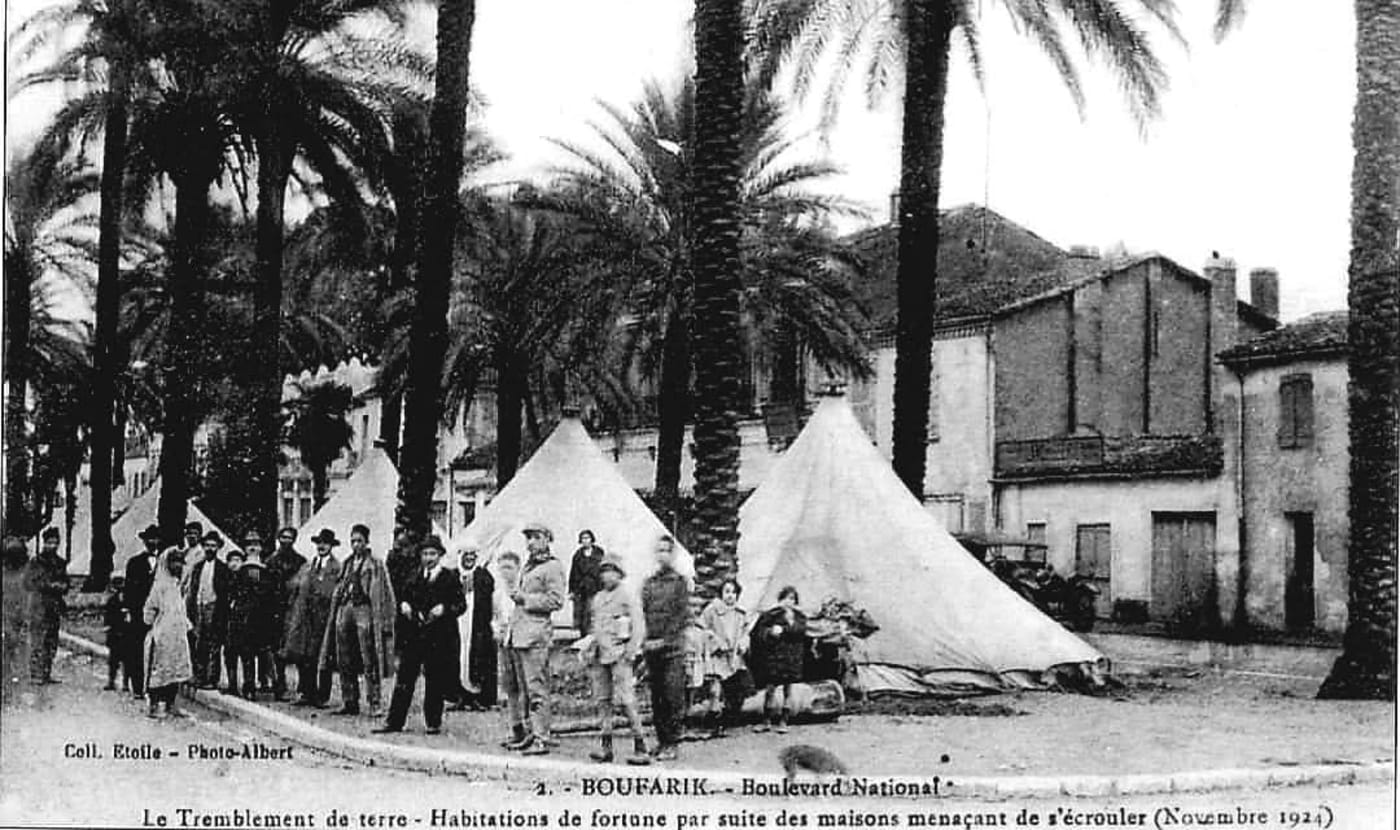
Earthquake of 1825
A catastrophic earthquake on 2 March 1825 nearly destroyed the entire city of Blida, killing thousands of residents and triggering a major French-supervised reconstruction.
1 January 2025
Overview
On 2 March 1825, a powerful earthquake struck Blida during the final years of Ottoman rule, causing catastrophic destruction. The shock was severe enough to collapse most of the city's structures, killing thousands of residents and leaving the walled city in ruins.
Aftermath and Reconstruction
The earthquake arrived just five years before the French invasion of Algeria (1830). The city had only partially recovered when French forces entered Blida in 1830. Colonial authorities subsequently undertook a systematic reconstruction of the urban fabric, replacing the Ottoman-era organic layout with a gridded European street plan — a decision that permanently altered Blida's architectural character.
The reconstruction period coincided with the arrival of European settlers and the transformation of Blida into a French colonial garrison town.
Connections
- The rebuilt city became the canvas for landmarks like the [[culture/architecture/music-kiosk|Music Kiosk]] and the [[culture/architecture/bazar-esserdouk|Bazar Esserdouk]]
- The [[culture/architecture/saint-charles-church|Saint-Charles Church]] and other colonial religious buildings date to this post-earthquake reconstruction era
- See also: [[archives/history/first-battle-of-blida|First Battle of Blida (1830)]] — the French military entry followed just five years after this disaster
- For the urban legacy of this era, see [[culture/architecture/villa-ourida|Villa Ourida]] and [[culture/architecture/villa-guglielmi|Villa Guglielmi]]